


Views: 0 Author: Site Editor Publish Time: 2026-09-16 Origin: Site


A container of PVC threaded fittings arrives at a UK distributor. The warehouse team picks up a 1/2″ male adapter, threads it into a 1/2″ female elbow, and it screws in smoothly — two, three turns, then it stops. It *fits*. It just never seals. By the time the leak shows up on a pressurised line, the container has been invoiced, installed, and is now a warranty claim.
This is not a manufacturing defect. It is a thread standard mismatch, and in the plastic pipe industry it is the single most expensive misunderstanding there is.
Here is why it happens. "1/2 inch" means something different in North America than it does in Europe, and the difference is invisible to the eye: 60° versus 55°. Both threads exist, both are sold as 1/2″, and at that one size they even share the same number of threads per inch. They are still not interchangeable.
Whether you buy, specify, or install PVC, CPVC, PPR, PE or PP pipe fittings, the thread standard on the end of the fitting decides whether the joint works. This guide covers the three thread systems that dominate global trade, the dimensions that matter, a region-by-region purchasing guide, and the installation rules that keep plastic threads from failing.
Most engineers learn thread standards on steel. Plastic behaves differently, and it changes the consequences of getting it wrong.
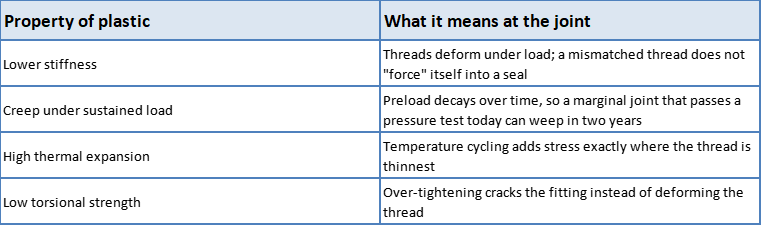
In metal pipework, a fitter can sometimes "make it work" with enough torque and sealant. In PVC and CPVC, that same approach produces a split fitting. In plastic piping, thread compatibility has to be engineered in at the specification stage — it cannot be forced at the installation stage.
Almost every threaded plastic pipe fitting sold worldwide uses one of these three thread forms.
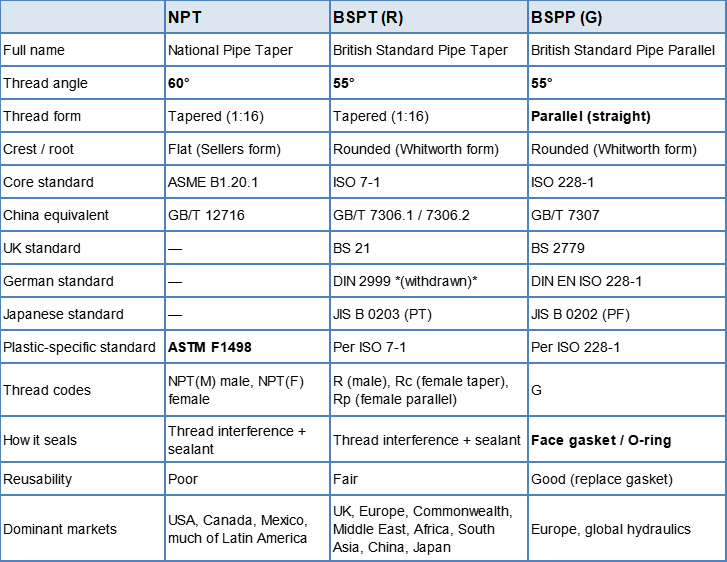
· NPT — the North American standard. 60° tapered thread, seals on the thread with PTFE tape or thread sealant. Used across PVC and CPVC threaded fittings in the US and Canada.
· BSPT (R) — the international workhorse. 55° tapered thread, seals on the thread with sealant. Dominant from Europe to the Middle East to South Asia.
· BSPP (G) — 55° *parallel* thread. The thread itself does not seal; a face gasket or O-ring does. Preferred where fittings are taken apart and reassembled.
For North American thermoplastic pipe and fittings, the governing document for tapered threads is ASTM F1498, "Standard Specification for Taper Pipe Threads 60° for Thermoplastic Pipe and Fittings." It defines the dimensions and gauging requirements for the 60° tapered threads moulded or cut onto plastic pipe and fittings. PVC threaded fittings are additionally specified under ASTM D2464 and CPVC threaded fittings under ASTM F437 — both Schedule 80, because threading removes wall material and Schedule 40 does not leave enough behind.
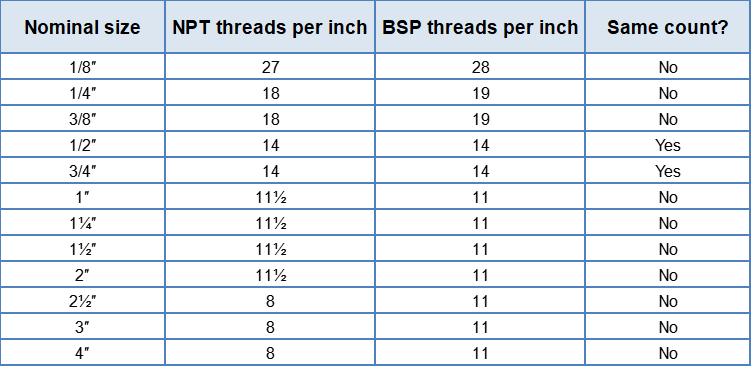
The most common source of confusion in thread selection is that nominal sizes are trade sizes, not measurements. A 1/2″ BSP thread has a major diameter of 20.955 mm. A 1/2″ NPT thread measures roughly 21.34 mm at the pipe end. Neither is anywhere near 12.7 mm.
That is why you cannot identify a thread with a tape measure alone. You need the thread count as well.
NPT (60° tapered)
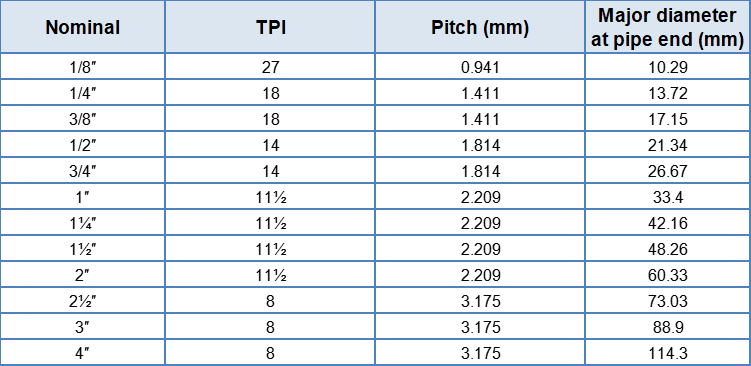
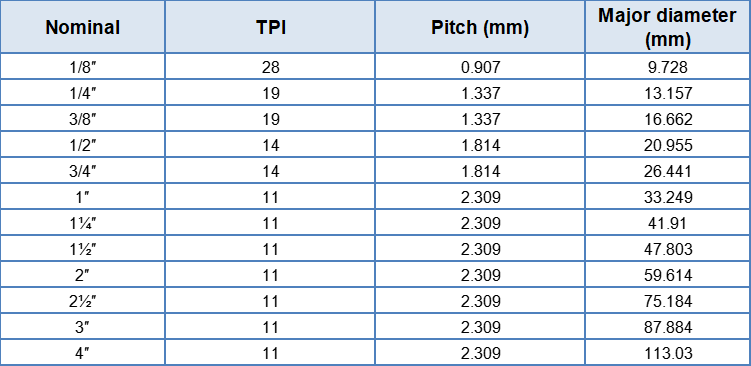
*Conversions: pitch (mm) = 25.4 ÷ TPI.*
Look again at the thread count table. At 1/2″ and 3/4″, NPT and BSP share the same thread count — 14 threads per inch.
That coincidence is the reason mismatches survive inspection. A 1/2″ NPT male adapter will thread into a 1/2″ BSP female fitting by hand. The fitter feels engagement, assumes compatibility, and tightens. But the flank angle is 60° on one and 55° on the other, so the threads never seat across a real contact area. Instead of a seal, you get a spiral leak path — plus a stress concentration that splits plastic fittings.
At every other size, the thread counts differ, so the mismatch fails fast and visibly. At 1/2″ and 3/4″, it fails slowly and expensively.
Rule of thumb for buyers: the two sizes most likely to be ordered incorrectly, and the two that will pass a visual check, are exactly the two sizes that account for most small-diameter plumbing connections. Verify them twice.
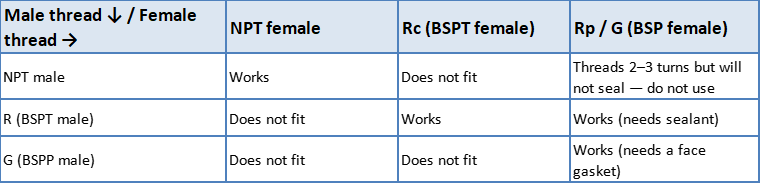
Three rules worth memorising:
1. A tapered male thread can enter a parallel female thread; a parallel male thread cannot enter a tapered female thread.
2. Tapered threads (NPT, BSPT) must have sealant. Parallel threads (BSPP) must have a face gasket — sealant on the thread does nothing.
3. Different thread angles (60° vs 55°) never mate, at any size, at any pressure.
If a project genuinely mixes standards — for example a European valve manifold installed on a North American line — the answer is a purpose-made NPT × BSP adapter, with each end sealed according to its own thread type. Adapters are a standard catalogue item precisely because mixed systems are common in retrofit and multi-vendor projects.
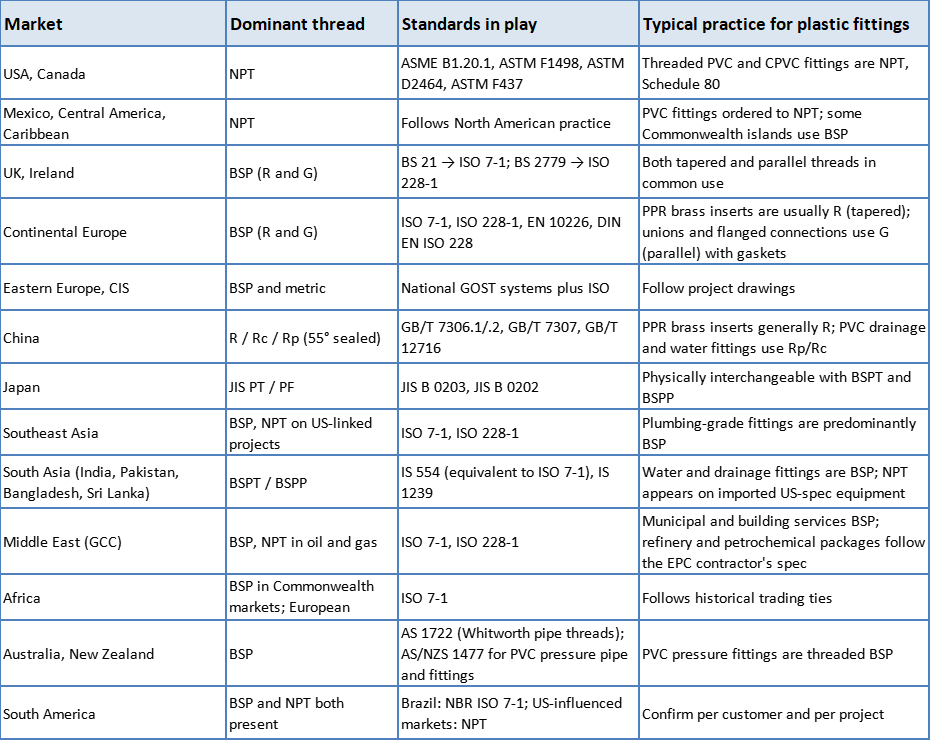
This is the table to check before you raise a purchase order. It reflects dominant market practice — not regulation. Within a single country, a petrochemical project may specify NPT while the municipal water sector buys BSP. Always confirm the thread code against the project specification or the counterpart component.
"Europe only uses BSPP." Not accurate. Tapered BSPT is used widely across European pipework. BSPP dominates in hydraulics, pneumatics and anywhere the joint is opened repeatedly, because the seal is independent of the thread.
"Japan has its own incompatible standard." JIS B 0203 (PT) and JIS B 0202 (PF) are dimensionally consistent with BSPT and BSPP and are interchangeable in practice. The difference is in designation and inspection convention, not the thread itself.
"Germany uses DIN 2999, which is different." DIN 2999 was the German adoption of the BS 21 Whitworth tapered pipe thread. It has been withdrawn and superseded by ISO 7 and ISO 228. If an older drawing calls out DIN 2999, manufacture to ISO 7-1 (R series).
The thread standard does not change with the material, but where the thread lives does.
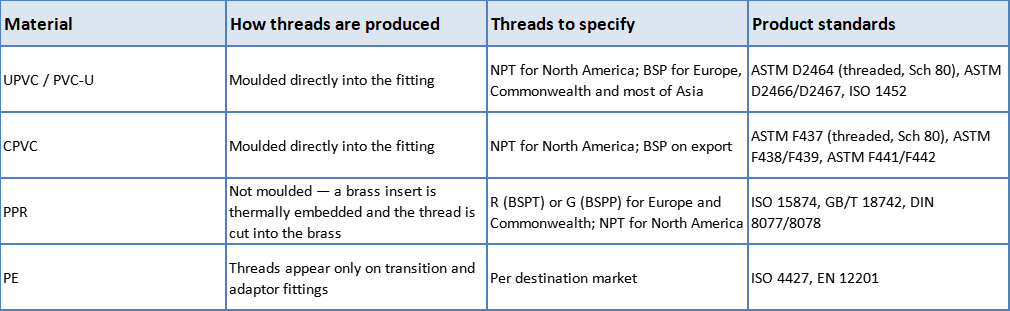
The PPR point deserves emphasis. A PPR transition fitting does not have a plastic thread. Its thread is on the brass insert. That means the same body moulding is sold as two different SKUs depending on destination — one with an R1/2 insert, one with a 1/2 NPT insert. Outwardly they look identical.
If you buy PPR fittings across multiple markets, specify the insert thread in writing on the PO, not verbally. "1/2 inch female" is not a specification.
Our PPR pipe fittings guide covers the material side in more depth, and the PPR installation guide covers jointing.
Do:
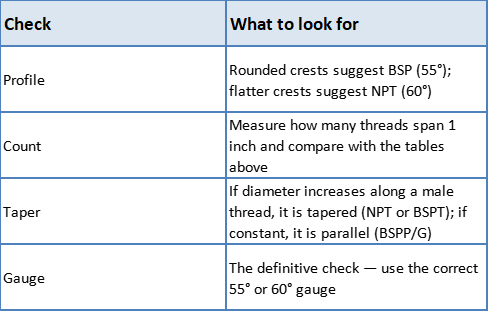
· Confirm the thread code with a thread gauge (55° and 60° gauges are different tools) before installation begins.
· Use PTFE tape or a solvent-free thread sealant on tapered threads. Wrap in the direction of engagement, two to three turns, leaving the first thread bare.
· Tighten by hand until snug, then a further one to two turns with a tool — no more.
· Use a face gasket or O-ring on all BSPP (G) joints, sized for the medium and temperature.
· Support the pipe either side of threaded joints so the thread is not carrying bending load.
· Clear all old sealant and replace gaskets on every reassembly.
Do not:
· Do not use solvent-based pipe dope formulated for metal pipework on PVC or CPVC. It can cause environmental stress cracking.
· Do not use a cheater bar, and do not "tighten a bit more" to stop a weep. On plastic, that ends in a split fitting.
· Do not assume a thread that starts easily is the correct thread. At 1/2″ and 3/4″, the wrong thread also starts easily.
· Do not exceed the fitting's pressure rating at the working temperature — plastic pressure ratings fall significantly as temperature rises.
Can a 1/2″ NPT fitting be used with a 1/2″ BSP fitting?
No. Although both use 14 threads per inch and will partly engage, the flank angles differ (60° vs 55°) and the joint cannot seal under pressure. On plastic fittings it also risks cracking the female component.
Is BSPT interchangeable with BSPP?
A tapered male (R) thread can be used with a parallel female (Rp) thread, which is the standard R-to-Rp combination, provided sealant is used. The reverse — a parallel male (G) thread into a tapered female — does not work.
Why does a BSPP (G) joint not need thread sealant?
Because a parallel thread provides no sealing geometry. The seal is made by a gasket or O-ring compressed against a machined face or shoulder. Adding tape to the thread does not improve sealing and can alter the engagement depth.
What thread do PPR fittings use?
The thread is cut on the embedded brass insert and follows the destination market — typically R (BSPT) or G (BSPP) for Europe, the Middle East, Africa and Asia, and NPT for North America. It must be specified explicitly on the order.
What is PT1/2″ on a drawing?
PT is the Japanese JIS B 0203 designation for tapered pipe thread, dimensionally the same as BSPT (R). PF is the equivalent for parallel threads (BSPP / G).
Can plastic threaded fittings be reused?
Tapered threads deform each time they are tightened and are generally good for two to three assemblies before replacement. Parallel (G) threads with a gasket can be opened and closed many times, replacing only the gasket.
Why are threaded PVC and CPVC fittings always Schedule 80?
Threading removes wall material. In Schedule 40, the remaining wall at the thread root is insufficient for pressure service, so threaded fittings are specified in the heavier Schedule 80 wall.
Thread standard selection comes down to three questions:
1. Which market is the system being installed in? That decides NPT versus BSP.
2. Will the joint be opened again? Repeat service favours BSPP with a face gasket over a tapered thread.
3. What is the medium and working temperature? That decides the material — and the material determines the pressure rating and derating.
Get those three right and the thread stops being a risk item on your project.
ERA manufactures UPVC, CPVC, PPR, PP, PPH and HDPE piping systems with an annual production capacity of 1.6 million tons. Because we supply both NPT and BSP markets, our production and quality teams gauge threads to the destination standard — 60° tapered threads per ASTM F1498 for North American orders, and 55° R/G threads per ISO 7-1 and ISO 228-1 for the rest — with dimensional and gauge checks built into daily production testing.
· Browse the full UPVC pipe fittings and valves range
· Review the international standards our systems are manufactured to
· See how we approach CPVC standards and in-factory thread testing
Ordering threaded fittings for an export project? Send us the thread code, the material and the pressure/temperature duty — NPT or BSP, male or female, Schedule 40 or 80 — and our technical team will confirm the specification before production. Contact ERA (https://www.erapipefittings.com/) for a quotation.


